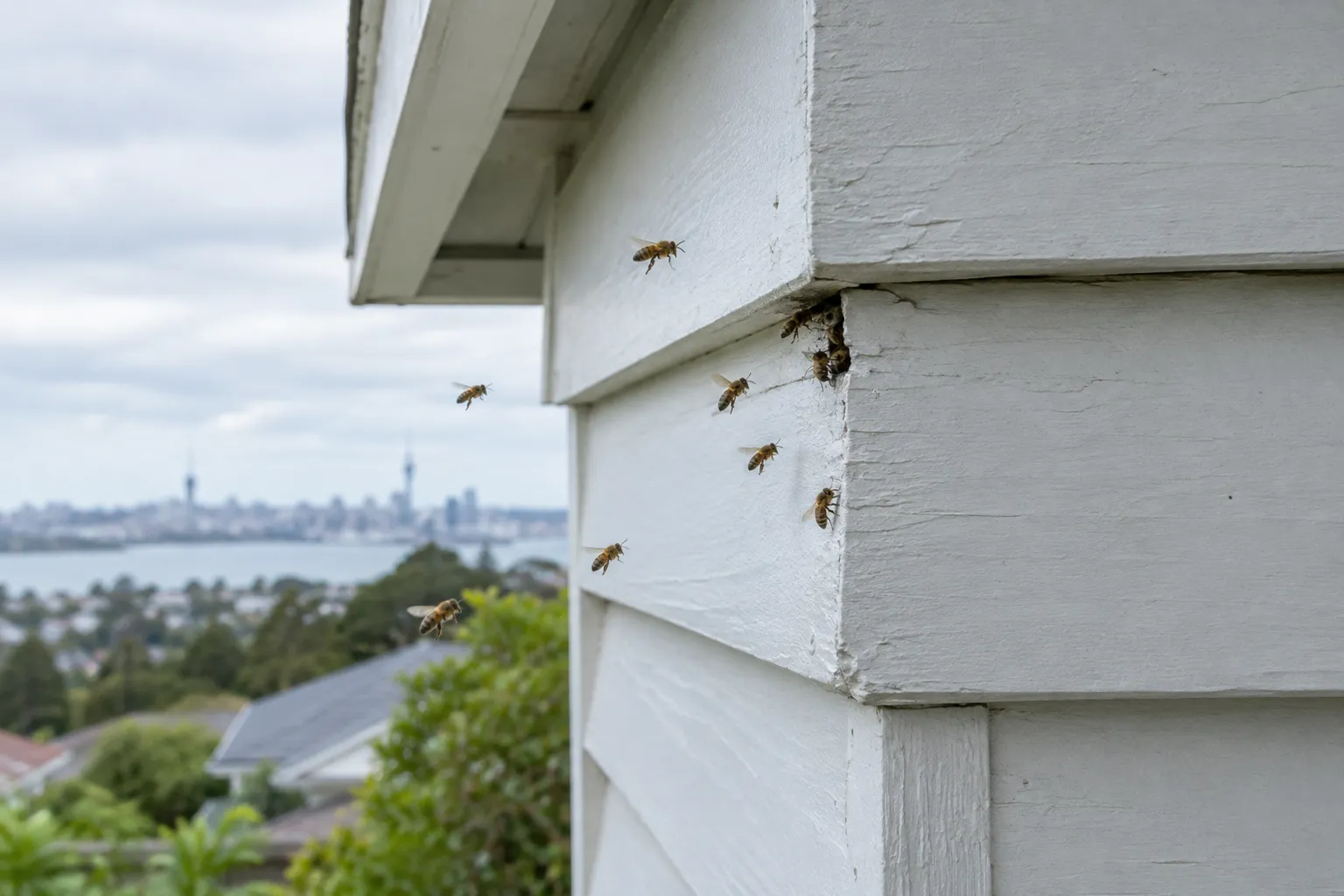
Bees nesting inside your house walls or roof are a different job from a swarm on a branch. If they are honey bees, the colony builds wax comb and stores honey inside the cavity, and the whole nest has to come out, usually by opening the wall or ceiling. If they are bumble bees, the nest is small, makes no honey and dies off within a few months, so leaving it is often an option. This page covers how to tell which you have, the signs of a nest inside a wall, why you should never just block the hole, and what a specialist does. For the bigger picture, start with bee removal in Auckland.
Are the bees in your wall honey bees or bumble bees?
Watch the entrance for a few minutes. Honey bees are small, brown and slim, and dozens come and go from the same hole every minute on a warm day. Bumble bees are large, round and fuzzy, often black with yellow or buff bands, and only a few fly in and out each hour. That difference decides almost everything that follows, so it is worth checking before you call anyone.
| Honey bees | Bumble bees | |
|---|---|---|
| Look | Small, brown, slim | Large, round, very hairy |
| Traffic at the hole | Constant, dozens a minute | A few an hour |
| Colony size | Thousands | A few dozen to a few hundred |
| Stores honey and wax comb | Yes, lots of it | No honey to speak of |
| How long the nest lasts | Years, if left | About 2 to 3 months, then it dies off |
If the bees are black and yellow with a smooth, shiny body and a narrow waist, they are probably wasps, not bees. That needs a pest control business rather than a beekeeper.
Bumble bee nests in walls, under floors and under houses are common because the queen picks dry, sheltered cavities such as old mouse nests. The NZ Bumblebee Conservation Trust notes they are not aggressive and cause no structural damage. Our page on bumble bee nests explains when to leave one and when to have it moved.
What are the signs of bees inside a wall cavity?
The clearest sign is a steady stream of bees using one gap: a crack in weatherboards, a gap at the eaves, a vent, a hole in the soffit or a space around a pipe. Other signs are a humming you can hear through the wall on a warm day, bees appearing inside rooms near light fittings, and, in older nests, a dark greasy stain or a sweet smell where honey has seeped through.
Look for these early. A colony that moved in this spring is smaller and easier to deal with than one that has been inside the structure for a year or more. Signs to note before you get quotes:
- Where the entrance is, and how high off the ground
- Roughly how many bees use it, and whether that number is growing
- How long you think they have been there
- Whether bees are getting into the house
- Any staining, damp patches or smell on the inside wall or ceiling
Write these down or take a short video. A specialist can usually give a better first quote from it.
Why does the whole nest have to come out?
A honey bee nest has to be fully removed because the comb, honey and wax do not go away when the bees do. University bee labs in Georgia and California both explain that once the bees are gone, nothing cools the comb, so it can melt and honey can seep through walls and ceilings. The old nest also attracts robbing bees and future swarms to the same cavity.
There is a disease reason too. NZ Bee Health and Biosecurity explains that American foulbrood, a fatal bacterial disease of honey bee brood caused by Paenibacillus larvae, spreads when weak or abandoned colonies are robbed by bees from nearby hives. A dead colony left inside a wall leaves exactly that kind of honey behind for other bees to find.
What happens if you block a bee hole?
Blocking the entrance of an active nest rarely fixes anything. The bees are still inside, and they look for another way out, which can be through a light fitting, a gap in a skirting board or a ceiling vent and into the house. If the colony dies behind the block, the comb and honey stay inside the cavity, with the problems above.
The right order is: remove the nest, clean out the cavity, then seal every gap the bees used. Sealing comes last, not first. UGA's bee lab also notes that the scent of an old nest makes a cavity especially attractive to future swarms, so the seal matters once the nest is out.
Can you kill bees in a wall with insecticide?
Spraying insecticide into a wall is not a good fix for an established honey bee colony. The University of Georgia notes it only really works if the bees moved in within the last day or two. After that, the dead bees, comb and honey stay in the wall. UC Riverside adds that poisoned honey is dangerous to any bees that rob it, and it can leak through the wall.
Honey and Bees New Zealand advises against spraying swarms for the same reason: it can make bees sick or kill them, and it does nothing about the comb. For a new swarm still hanging outside, the better move is a swarm collector. Our page on bee swarm removal covers that.
How does a specialist remove bees from a wall or roof?
For an established honey bee colony, removal almost always means opening the wall, ceiling or roof space, cutting out all of the comb, collecting the bees, then cleaning the cavity and sealing it. Many specialists try to save the bees and rehome them in a hive. The opening then has to be repaired, sometimes by a builder.
What that looks like on the day:
- The specialist works out where the nest sits, by watching where the bees go and by listening and tapping along the wall.
- They open the cladding, lining or ceiling over the nest.
- They cut out the comb and honey and collect the bees, including the queen if they can find her.
- They clean the cavity so nothing is left to melt or attract other bees.
- They seal the entrance and, depending on the quote, close up the wall.
Anyone who keeps the rescued bees in a hive has to be a registered beekeeper under the American Foulbrood National Pest Management Plan. Ask whether the quote includes repairs, or only the bee removal. That is the biggest difference between quotes. Our guide to bee removal cost covers the price ranges.
Questions people ask
How long does removing bees from a wall take?
Most wall or roof removals take a few hours on site. A small, recent nest near an easy opening can be done in an hour or two. A large, established colony high up or spread across several framing bays can take most of a day, and repairs to the cladding or ceiling may happen on a separate visit.
Do I need to be home for the removal?
Usually, yes, at least at the start. The specialist needs access to the outside of the wall and often to the room or roof space behind it. Keep children and pets inside and away from the area while the nest is open, because bees fly more while their comb is being cut out.
What should I ask before I hire someone to remove bees from a wall?
Ask whether they remove the bees alive or kill them, whether they take out all of the comb and honey, and whether the price includes opening and repairing the wall. Ask how they seal the entrance afterwards, what happens if bees return, and whether they are a registered beekeeper if they keep the bees.
Will bees come back to the same wall?
They can. An old nest cavity smells attractive to new swarms, which is why removing every piece of comb and sealing the entrance properly matters. If a cavity has had bees before, check it each spring during swarm season, which in New Zealand can run from August to January.
Can I leave bumble bees in my wall?
Often, yes. A bumble bee nest lasts only about two to three months. The old queen, workers and males then die, and only new queens leave to hibernate. There is no honey to melt or attract other bees. If the entrance is away from doors and paths, many people simply wait it out and seal the gap in winter.
Sources
Last updated